
- Gold Au $3857.40 $1.54
- Silver Ag $47.41 $0.40
- Platinum Pt $1436.40 $-15.57
- Palladium Pd $982.00 $10.98
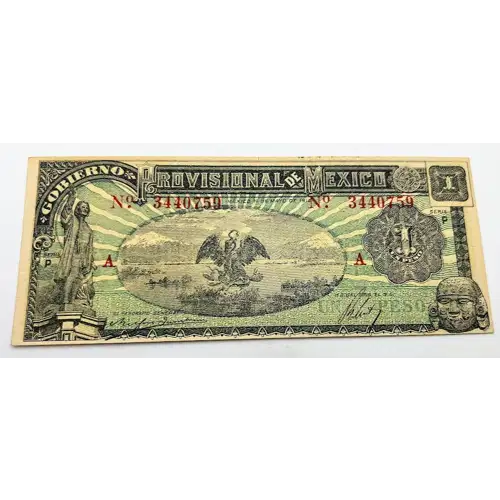
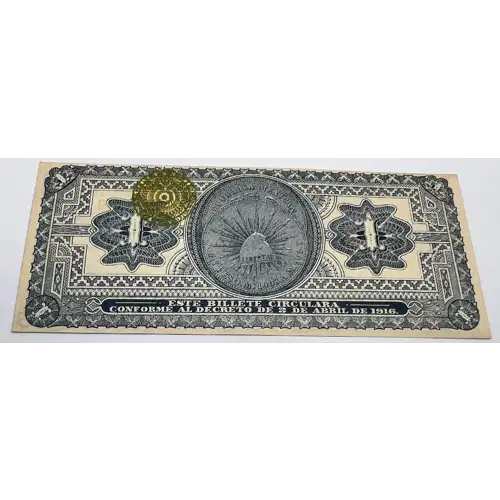
1916 Mexico Revolutionary Gobierno 1 Peso P-S709 UNC Uncirculated Crisp No Folds
Description
This 1916 Mexico 1 Peso banknote was issued by the Provisional Government of Mexico during the Mexican Revolution and represents an attractive example of revolutionary-era paper currency from one of the most significant periods of political and economic transformation in Mexican history. Cataloged as Pick S709, this distinctive note was issued in Mexico City on May 1, 1916, during the revolutionary administration of Venustiano Carranza, whose Constitutionalists were working to consolidate national authority and restore financial stability following years of conflict. The face features an elaborate engraved composition incorporating a standing allegorical female figure on the left, representing liberty and the ideals of the Mexican Republic. At the center is a striking vignette of the Mexican national eagle perched upon a cactus with a serpent, set against a scenic landscape featuring distant mountains and waterways. Radiating green security patterns extend behind the central design, creating an impressive visual effect complemented by intricate ornamental borders, decorative denomination panels, and matching red serial numbers 3440750. Additional symbolic elements include a detailed sculptural head in the lower right corner, official signatures, and the Series P identification. The reverse features an exceptionally elaborate geometric design printed predominantly in dark blue and black, with symmetrical ornamental patterns surrounding a large central emblem depicting a traditional liberty cap with radiating rays. The central motif symbolizes freedom and republican government, while intricate decorative borders, geometric security patterns, and prominent denomination numerals complete the composition. An additional circular gold-colored official seal or overprint appears near the upper left portion of the reverse, adding distinctive visual and historical interest to the note. The intricate printing and detailed ornamental elements demonstrate the sophisticated security features employed in Mexican revolutionary currency during the early twentieth century. This example survives in attractive Crisp Uncirculated (UNC) condition, retaining well-preserved paper, strong original coloration, and excellent definition throughout the printed details. The note exhibits no visible folds, maintaining an appealing crisp appearance with clearly presented engraved imagery, ornamental borders, serial numbers, and official markings. The contrasting green and black face design, dark reverse printing, and gold-colored seal contribute to its impressive overall presentation. The 1916 date places this issue within an important transitional period in Mexican history, when Venustiano Carranza's Constitutionalists were attempting to establish a more stable national government following the overthrow of Victoriano Huerta and the subsequent conflicts among revolutionary factions. Mexico's monetary system had experienced considerable disruption as numerous regional authorities, military leaders, and provisional administrations issued competing forms of paper currency. These widespread issues contributed to inflation, uncertainty, and declining public confidence in circulating banknotes. The Provisional Government currency issued in 1916 formed part of the broader efforts to reorganize the nation's financial system and establish more consistent governmental control over monetary circulation. The period ultimately led to the adoption of the Mexican Constitution of 1917, which established an important foundation for the country's modern political institutions. As an authentic artifact of the Mexican Revolution, this 1916 Provisional Government 1 Peso banknote offers collectors a tangible connection to the nation's revolutionary struggles, monetary reforms, and political transformation. Its Crisp Uncirculated condition with no folds, collectible Pick S709 attribution, Mexico City issuance, distinctive Series P identification, elaborate national eagle vignette, and attractive official seal make it a desirable addition to collections of Mexican revolutionary currency, Latin American banknotes, and early twentieth-century world paper money.