- Gold Au $3856.80 $0.77
- Silver Ag $47.38 $0.37
- Platinum Pt $1436.40 $-15.57
- Palladium Pd $982.00 $10.98
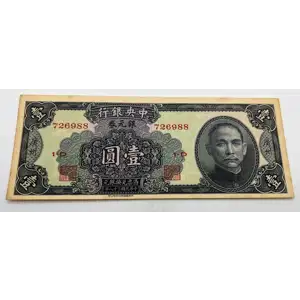
1936 Republic of China 1 Yuan AU / UNC P-212 World Paper Money Currency TLDR
Description
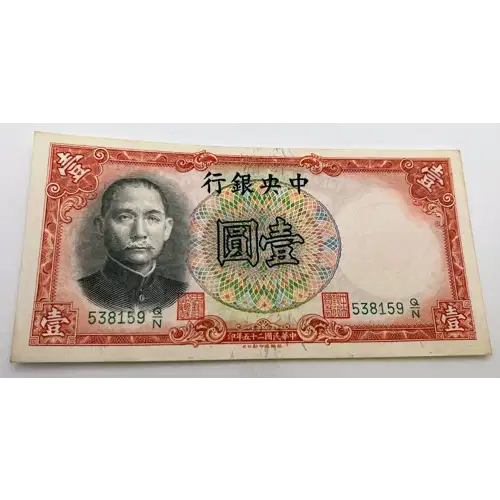
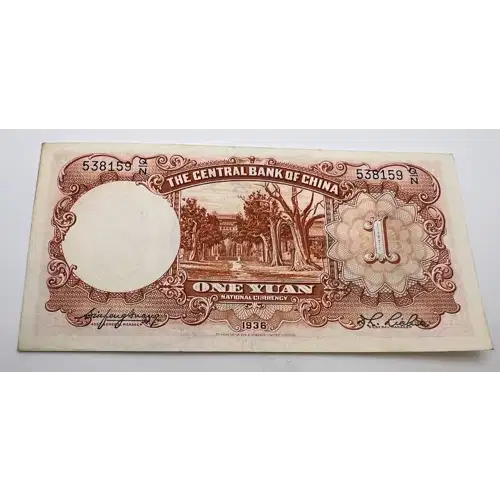
This 1936 Republic of China 1 Yuan banknote was issued by the Central Bank of China during the Nationalist government and represents an attractive example of prewar Chinese paper currency from an important period of monetary reform and financial modernization. Cataloged as Pick-212, this distinctive issue was printed by Thomas De La Rue & Company Limited of London, a renowned British security printing firm recognized for its exceptional engraving, elaborate banknote designs, and sophisticated anti-counterfeiting techniques. The Chinese-language side prominently features a finely engraved portrait of Dr. Sun Yat-sen, the revolutionary leader and founding father of the Republic of China, positioned on the left side of the note. His portrait is complemented by an elaborate circular security design incorporating intricate interwoven geometric patterns in shades of green, orange, yellow, and blue, creating a striking multicolored centerpiece. Traditional Chinese decorative elements, official red seals, denomination markings, and matching serial numbers 538159 complete the composition, while the reddish-brown ornamental borders provide an elegant contrast against the lighter paper background. The English-language side features a detailed architectural engraving depicting a traditional Chinese courtyard with a prominent building framed by mature trees and landscaped grounds. The central vignette showcases historic Chinese architecture, with carefully rendered trees, pathways, and structural details contributing to the scenic composition. An ornate denomination panel appears on the right, surrounded by intricate geometric security patterns and decorative scrollwork printed in reddish-brown tones. The year 1936, official bank signatures, and identification of the Central Bank of China complete the design, demonstrating the fine craftsmanship employed in its production. This example survives in attractive About Uncirculated to Uncirculated (AU/UNC) condition, displaying well-preserved paper, strong remaining color, and excellent definition throughout the printed details. The note retains an appealing overall presentation, with the intricate ornamental borders, Sun Yat-sen portrait, multicolored central security design, and architectural vignette remaining clearly defined. The contrasting reddish-brown printing and vibrant geometric elements highlight the quality of the original engraving, while the matching serial numbers and official seals contribute to its collectible appeal. The 1936 issue holds particular historical significance because it was produced shortly after China's landmark monetary reforms of November 1935, which replaced the traditional silver-based monetary system with a national paper currency intended to establish greater financial stability and centralize monetary authority. These reforms represented a major development in China's economic history, strengthening the role of the Central Bank of China and helping create a more unified national monetary system. Issued during the years immediately preceding the outbreak of full-scale war between China and Japan in 1937, this banknote also provides a tangible connection to the final period of relative economic reconstruction under the Nationalist government. The Central Bank of China's currency issues from this era reflect the country's efforts to modernize its financial institutions, expand the use of nationally administered paper money, and support commercial activity during a period of substantial political and economic change. As an authentic artifact of Republican China, this 1936 Central Bank of China 1 Yuan banknote offers collectors an appealing combination of historical significance, artistic craftsmanship, and attractive preservation. Its AU/UNC condition, collectible Pick-212 attribution, recognizable Sun Yat-sen portrait, elaborate Thomas De La Rue engraving, and distinctive multicolored security design make it a desirable addition to collections of Chinese paper money, Asian banknotes, and twentieth-century world currency.