- Gold Au $3856.80 $0.77
- Silver Ag $47.38 $0.37
- Platinum Pt $1436.40 $-15.57
- Palladium Pd $982.00 $10.98
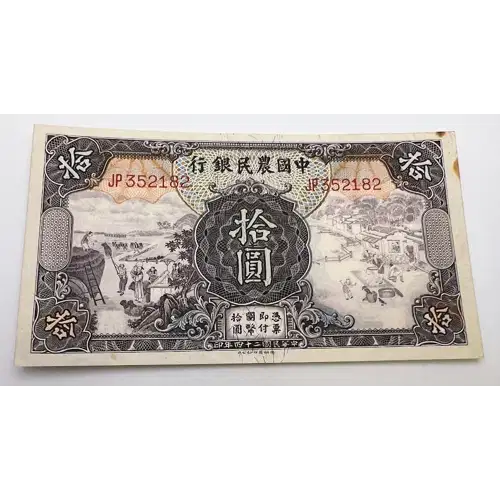
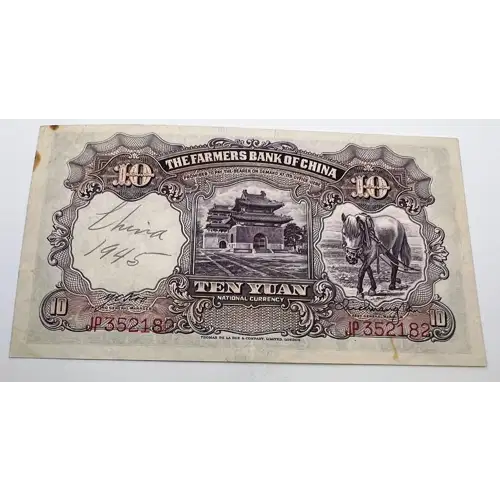
1935 Republic of China 10 Yuan Farmers Bank P-459 XF AU -Signature Paper Currency
Description
This 1935 Republic of China 10 Yuan banknote was issued by the Farmers Bank of China during the Nationalist government and represents an attractive example of prewar Chinese paper currency from an important period of financial modernization and agricultural development. Cataloged as Pick-459, this distinctive issue was printed by Thomas De La Rue & Company Limited of London, a renowned British security printing firm recognized for its detailed engraving, elaborate banknote designs, and sophisticated anti-counterfeiting techniques. The Farmers Bank of China played an important role in the country's financial system, particularly through its association with agricultural financing, rural economic development, and the expansion of banking services during the Republican era. The Chinese-language side features an elaborate central denomination panel surrounded by intricate geometric security patterns, decorative scrollwork, and finely engraved ornamental borders in dark brown and black tones. On either side of the central design are detailed rural scenes depicting traditional Chinese agricultural life, including farmers working near cultivated fields, waterways, village buildings, and surrounding landscapes. These illustrations reflect the bank's connection to China's agricultural economy and the importance of farming communities to the nation's economic development. Matching red serial numbers JP352182, traditional Chinese decorative elements, and official denomination markings complete the composition. The English-language side features a beautifully engraved architectural vignette of a traditional Chinese ceremonial gateway or monumental building, prominently positioned at the center of the note. The structure displays an ornate multi-tiered roof, detailed columns, and a broad paved courtyard, illustrating the architectural heritage of China. To the right is a finely detailed depiction of a harnessed horse standing in a rural landscape, further emphasizing the agricultural and transportation themes associated with the Farmers Bank of China. An ornate denomination panel appears beneath the central architectural scene, surrounded by intricate ornamental borders, elaborate geometric designs, and additional denomination numerals. The note also features an unusual handwritten signature or notation on the left side of the English-language face, adding an interesting individual characteristic to this particular example. This example survives in attractive Extremely Fine to About Uncirculated (XF/AU) condition, displaying well-preserved paper, strong remaining color, and excellent definition throughout the engraved details. The note retains an appealing overall presentation, with the intricate ornamental borders, agricultural scenes, architectural vignette, and detailed horse engraving remaining clearly presented. Natural paper toning and localized discoloration are visible, particularly along portions of the margins, while the handwritten notation provides an additional distinguishing feature. The 1935 date places this banknote within a particularly important period of Chinese monetary history, as the Nationalist government was pursuing major financial reforms intended to strengthen the country's banking system and stabilize its currency. In November 1935, China introduced a landmark monetary reform that replaced the traditional silver-based system with a national paper currency, fundamentally changing the structure of the country's financial institutions. The Farmers Bank of China was among the major institutions participating in the development of the national monetary system, and its currency issues reflected the growing importance of government-supported banking and agricultural finance. During this period, China remained predominantly agricultural, with rural communities forming the foundation of much of the nation's economy. The bank's use of farming imagery, traditional architecture, and a working horse underscores the importance of agriculture, transportation, and economic development during the Republican era. Issued shortly before the outbreak of full-scale war between China and Japan in 1937, this note also provides a tangible connection to the final years of relative economic reconstruction under the Nationalist government. As an authentic artifact of Republican China, this 1935 Farmers Bank of China 10 Yuan banknote offers collectors an appealing combination of historical significance, elaborate artistic craftsmanship, and distinctive rural imagery. Its XF/AU condition, collectible Pick-459 attribution, detailed Thomas De La Rue engraving, agricultural scenes, architectural vignette, and unusual handwritten signature make it a desirable addition to collections of Chinese paper money, agricultural-themed banknotes, Asian currency, and early twentieth-century world paper money.