- Gold Au $3856.80 $0.77
- Silver Ag $47.38 $0.37
- Platinum Pt $1436.40 $-15.57
- Palladium Pd $982.00 $10.98
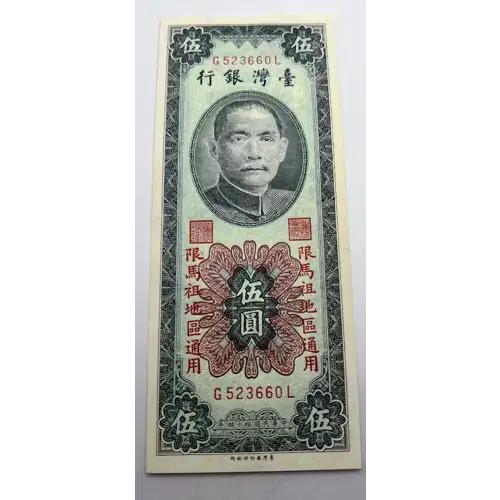
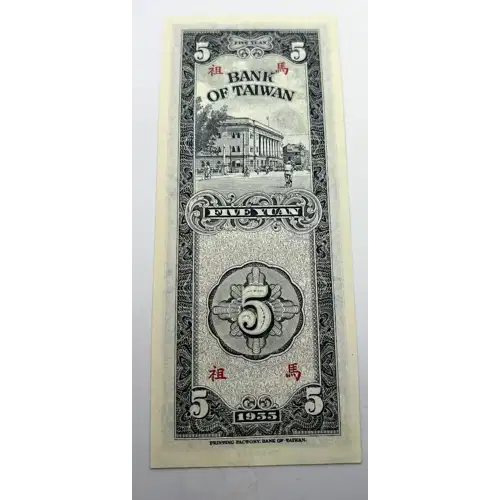
1955 Taiwan Matsu Island 5 Yuan UNC Uncirculated P-R121 Crisp Paper Money Currency
Description
This 1955 Taiwan 5 Yuan banknote was issued by the Bank of Taiwan specifically for circulation in the Matsu Islands, a strategically important island group administered by the Republic of China. Cataloged as Pick R121, this distinctive regional issue represents an attractive example of Taiwanese paper currency from the early Cold War period, when the offshore islands of Matsu and Kinmen played vital roles in the defense of the Republic of China against Communist forces on the mainland. Printed by the Printing Factory of the Bank of Taiwan, this note features an unusual vertical format, intricate security engraving, and distinctive red overprints identifying its restricted circulation within the Matsu Islands. The portrait side prominently features a finely engraved image of Dr. Sun Yat-sen, the revolutionary leader and founding father of the Republic of China, positioned within an elegant oval frame near the upper center of the design. His portrait is surrounded by intricate green geometric security patterns and elaborate black ornamental borders, complemented by official red seals and matching serial numbers G523660L. Beneath the portrait is an impressive symmetrical decorative design incorporating red floral and geometric elements surrounding the central denomination panel. The special Matsu Islands overprints appear along both sides of this design, distinguishing the note from regular Bank of Taiwan currency and emphasizing its designated regional circulation. The opposite side features a detailed architectural engraving of a substantial multistory building overlooking an active city street, with pedestrians, cyclists, and surrounding structures contributing to the urban scene. The building's prominent columns, symmetrical facade, and architectural detailing reflect the institutional development and modernization of Taiwan during the mid-twentieth century. Below the vignette is a large decorative denomination panel surrounded by elaborate scrollwork and intricate geometric patterns, while additional denomination numerals appear in the corners. The year 1955 and identification of the Bank of Taiwan's printing facility complete the design. This example survives in attractive Crisp Uncirculated (UNC) condition, displaying well-preserved paper, strong original coloration, and excellent definition throughout the engraved details. The note retains an appealing crisp appearance, with the Sun Yat-sen portrait, architectural vignette, intricate ornamental borders, and distinctive Matsu Islands overprints remaining clearly presented. The contrasting black and green engraving, vibrant red overprints, and light paper background create an attractive visual composition, highlighting the craftsmanship of this regional currency issue. The 1955 date places this banknote within a particularly significant period in the history of the Taiwan Strait, shortly after the First Taiwan Strait Crisis of 1954–1955. During this confrontation, the Republic of China maintained military control over the offshore islands of Matsu and Kinmen despite their close proximity to the Chinese mainland. These territories became important defensive positions and symbols of the continuing political division between the Republic of China and the People's Republic of China. Special currency issues designated for circulation in the offshore islands reflected their unique administrative, military, and economic circumstances, allowing authorities to regulate local monetary circulation separately from Taiwan's principal currency system. The Matsu Islands designation gives this note additional historical interest, connecting it directly to the geopolitical tensions and regional financial arrangements of the early Cold War. As an authentic artifact of mid-twentieth-century Taiwanese history, this 1955 Bank of Taiwan 5 Yuan Matsu Islands banknote offers collectors an appealing combination of historical significance, distinctive regional issuance, and attractive preservation. Its Crisp Uncirculated condition, collectible Pick R121 attribution, recognizable Sun Yat-sen portrait, unusual vertical design, special Matsu Islands overprints, and detailed architectural engraving make it a desirable addition to collections of Taiwanese paper money, offshore island currency, Asian banknotes, and Cold War-era world paper money.