50,000 Y

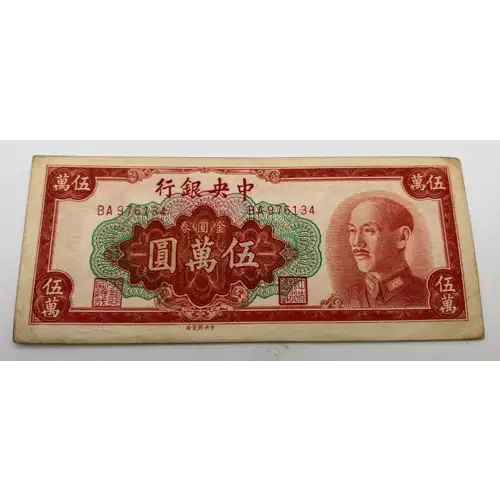
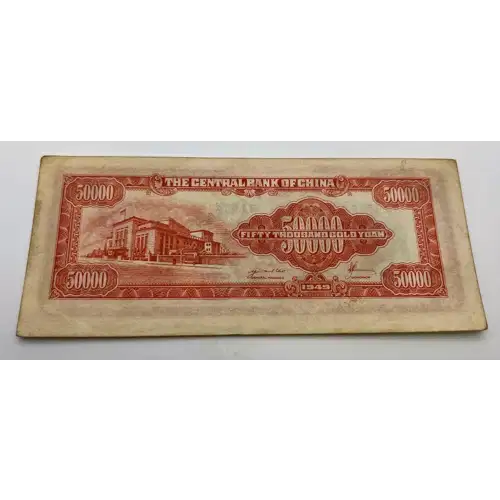
This 1949 Republic of China 50,000 Gold Yuan banknote was issued by the Central Bank of China during the final tumultuous months of the Nationalist government's rule on the Chinese mainland and represents a fascinating example of high-denomination Chinese paper currency from one of the most significant periods of monetary instability in modern history. Cataloged as Pick-418, this distinctive issue was produced during the closing stages of the Chinese Civil War, when rapidly accelerating inflation and the deterioration of the Nationalist government's financial position necessitated the issuance of increasingly large currency denominations. The Chinese-language side prominently features an engraved portrait of Chiang Kai-shek, the Nationalist leader and president of the Republic of China, positioned on the right in military uniform. His portrait is complemented by an elaborate central denomination panel surrounded by intricate geometric security patterns, decorative scrollwork, and ornamental elements printed in contrasting reddish-brown and green tones. Traditional Chinese characters, official red seals, and matching serial numbers BA976134 complete the composition, while finely detailed borders frame the overall design. The English-language side features an architectural engraving depicting a substantial government or institutional building with a broad entrance, prominent columns, and surrounding grounds. The building is accompanied by a large decorative denomination panel displaying the value of fifty thousand Gold Yuan, surrounded by intricate geometric patterns and ornamental flourishes. Additional denomination numerals appear in all four corners, while official bank signatures and the year 1949 complete the design. Printed predominantly in reddish-brown tones, the reverse presents an attractive contrast between the detailed architectural vignette and the surrounding ornamental engraving. This example survives in Very Fine Plus (VF+) condition, displaying appealing remaining coloration, well-defined printed details, and an attractive overall presentation. The paper exhibits natural age-related toning with warm cream and tan coloration, particularly along the margins, while the portrait, architectural vignette, denomination panels, serial numbers, and official seals remain clearly presented. The note retains the distinctive character associated with circulated Republican-era Chinese currency and offers an appealing representation of this historic high-denomination issue. The 1949 date carries exceptional historical significance because it marks the final year of Nationalist government control over mainland China and the collapse of the Gold Yuan monetary system. Introduced in August 1948, the Gold Yuan was intended to replace the heavily depreciated fabi currency and restore public confidence in China's financial system. However, continued government deficit financing, the enormous costs of the Chinese Civil War, and widespread economic disruption contributed to accelerating inflation that rapidly undermined the new currency. Within months of its introduction, the Gold Yuan experienced severe depreciation, forcing the government to issue increasingly large denominations, including this 50,000 Yuan note. By 1949, the Gold Yuan had effectively lost public confidence, and the Nationalist government attempted another monetary reform through the introduction of the Silver Yuan before ultimately retreating to Taiwan. The Central Bank of China's high-denomination issues from this period serve as tangible reminders of the extraordinary economic difficulties that accompanied the final stages of the Chinese Civil War and the establishment of the People's Republic of China in October 1949. As an authentic artifact of this pivotal moment in Chinese history, this 1949 Central Bank of China 50,000 Gold Yuan banknote offers collectors an appealing combination of historical significance, distinctive high-denomination design, and intricate Republican-era engraving. Its Very Fine Plus condition, collectible Pick-418 attribution, recognizable Chiang Kai-shek portrait, detailed architectural vignette, and direct connection to the collapse of China's Gold Yuan currency make it a desirable addition to collections of Chinese paper money, hyperinflation currency, Asian banknotes, and twentieth-century world financial history.

Product ID 556087
Series Year 1949, 1949 Gold Chin Yuan Issues
Country China
Denomination 50,000 Y
Grading Agency
Grade
Signature -
Category Republic
Serial No
Status Active
Seal -
Fr / Pick # 418
Additional Info -

You must be authenticated to write reviews. Click here   to login.

There are no reviews yet. Be the first to write one!

1949 Republic of China 50,000 Yuan Fifty Thousand Gold Yuan P-418 VF+

– +

Description

This 1949 Republic of China 50,000 Gold Yuan banknote was issued by the Central Bank of China during the final tumultuous months of the Nationalist government's rule on the Chinese mainland and represents a fascinating example of high-denomination Chinese paper currency from one of the most significant periods of monetary instability in modern history. Cataloged as Pick-418, this distinctive issue was produced during the closing stages of the Chinese Civil War, when rapidly accelerating inflation and the deterioration of the Nationalist government's financial position necessitated the issuance of increasingly large currency denominations. The Chinese-language side prominently features an engraved portrait of Chiang Kai-shek, the Nationalist leader and president of the Republic of China, positioned on the right in military uniform. His portrait is complemented by an elaborate central denomination panel surrounded by intricate geometric security patterns, decorative scrollwork, and ornamental elements printed in contrasting reddish-brown and green tones. Traditional Chinese characters, official red seals, and matching serial numbers BA976134 complete the composition, while finely detailed borders frame the overall design. The English-language side features an architectural engraving depicting a substantial government or institutional building with a broad entrance, prominent columns, and surrounding grounds. The building is accompanied by a large decorative denomination panel displaying the value of fifty thousand Gold Yuan, surrounded by intricate geometric patterns and ornamental flourishes. Additional denomination numerals appear in all four corners, while official bank signatures and the year 1949 complete the design. Printed predominantly in reddish-brown tones, the reverse presents an attractive contrast between the detailed architectural vignette and the surrounding ornamental engraving. This example survives in Very Fine Plus (VF+) condition, displaying appealing remaining coloration, well-defined printed details, and an attractive overall presentation. The paper exhibits natural age-related toning with warm cream and tan coloration, particularly along the margins, while the portrait, architectural vignette, denomination panels, serial numbers, and official seals remain clearly presented. The note retains the distinctive character associated with circulated Republican-era Chinese currency and offers an appealing representation of this historic high-denomination issue. The 1949 date carries exceptional historical significance because it marks the final year of Nationalist government control over mainland China and the collapse of the Gold Yuan monetary system. Introduced in August 1948, the Gold Yuan was intended to replace the heavily depreciated fabi currency and restore public confidence in China's financial system. However, continued government deficit financing, the enormous costs of the Chinese Civil War, and widespread economic disruption contributed to accelerating inflation that rapidly undermined the new currency. Within months of its introduction, the Gold Yuan experienced severe depreciation, forcing the government to issue increasingly large denominations, including this 50,000 Yuan note. By 1949, the Gold Yuan had effectively lost public confidence, and the Nationalist government attempted another monetary reform through the introduction of the Silver Yuan before ultimately retreating to Taiwan. The Central Bank of China's high-denomination issues from this period serve as tangible reminders of the extraordinary economic difficulties that accompanied the final stages of the Chinese Civil War and the establishment of the People's Republic of China in October 1949. As an authentic artifact of this pivotal moment in Chinese history, this 1949 Central Bank of China 50,000 Gold Yuan banknote offers collectors an appealing combination of historical significance, distinctive high-denomination design, and intricate Republican-era engraving. Its Very Fine Plus condition, collectible Pick-418 attribution, recognizable Chiang Kai-shek portrait, detailed architectural vignette, and direct connection to the collapse of China's Gold Yuan currency make it a desirable addition to collections of Chinese paper money, hyperinflation currency, Asian banknotes, and twentieth-century world financial history.
Specifications

Your Cart


Continue to Checkout