- Gold Au $3857.40 $1.54
- Silver Ag $47.41 $0.40
- Platinum Pt $1436.40 $-15.57
- Palladium Pd $982.00 $10.98
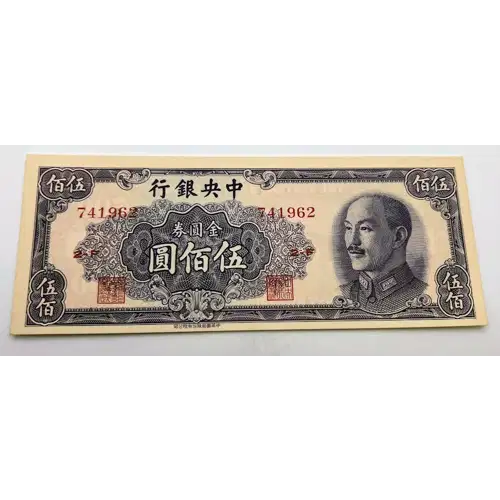
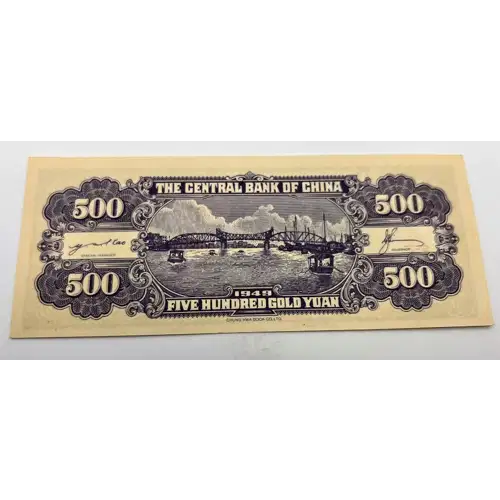
1949 Republic of China 500 Yuan P-410 Five Hundred Gold Yuan UNC Uncirculated
Description
This 1949 Republic of China 500 Gold Yuan banknote was issued by the Central Bank of China during the final years of the Nationalist government's administration on the Chinese mainland and represents an attractive example of Chinese paper currency from one of the most significant periods of economic and political transformation in modern Chinese history. Cataloged as Pick-410, this distinctive issue was printed by Chung Hwa Book Company, Ltd., a prominent Chinese printing and publishing firm associated with the production of official documents and banknotes during the Republican era. The note features elaborate engraving, intricate ornamental designs, and historically significant imagery reflecting the artistic traditions and monetary developments of late Republican China. The Chinese-language side prominently features a finely engraved portrait of Chiang Kai-shek, the Nationalist leader and president of the Republic of China, positioned on the right in military uniform. His portrait is complemented by an elaborate central denomination panel surrounded by intricate geometric security patterns, decorative scrollwork, and finely engraved ornamental elements printed in dark purple and black tones. Traditional Chinese decorative motifs, official red seals, and red serial numbers complete the composition, while symmetrical denomination panels and detailed borders enhance the note's visual appeal. The English-language side features an impressive maritime engraving depicting a busy waterfront scene with a prominent steel bridge spanning a broad waterway. Numerous boats and vessels appear along the river, while industrial structures and buildings line the distant shoreline beneath a cloud-filled sky. The detailed vignette illustrates the importance of transportation, commerce, and modern infrastructure to China's developing economy during the early twentieth century. Large denomination panels displaying the value of five hundred Gold Yuan appear on either side of the central scene, surrounded by elaborate floral patterns, geometric security designs, and decorative scrollwork. The year 1949, official bank signatures, and identification of the Central Bank of China complete the composition, demonstrating the craftsmanship employed in its production. This example survives in attractive Uncirculated (UNC) condition, displaying well-preserved paper, strong remaining coloration, and excellent definition throughout the printed details. The note retains an appealing crisp appearance, with the intricate ornamental borders, Chiang Kai-shek portrait, central denomination panel, and detailed maritime vignette remaining clearly presented. The contrasting dark purple printing and lighter paper background highlight the elaborate engraving, while the official seals and decorative elements contribute to the note's distinctive collectible character. The 1949 date carries exceptional historical significance because it marks the final year of Nationalist government control over mainland China and the collapse of the Gold Yuan monetary system. Introduced in August 1948, the Gold Yuan was intended to replace the heavily depreciated fabi currency and restore confidence in China's financial institutions. However, continued government expenditures, the enormous costs of the Chinese Civil War, and widespread economic instability contributed to rapidly accelerating inflation that undermined the new currency. Within months of its introduction, the Gold Yuan experienced severe depreciation, forcing the government to issue increasingly large denominations as the purchasing power of circulating banknotes declined. By 1949, the Gold Yuan had effectively lost public confidence, and the Nationalist government attempted another monetary reform through the introduction of the Silver Yuan before ultimately relocating to Taiwan. Banknotes from this period serve as tangible reminders of the extraordinary monetary challenges that accompanied the final stages of the Chinese Civil War and the establishment of the People's Republic of China in October 1949. As an authentic artifact of late Republican China, this 1949 Central Bank of China 500 Gold Yuan banknote offers collectors an appealing combination of historical significance, elaborate artistic craftsmanship, and attractive preservation. Its Uncirculated condition, collectible Pick-410 attribution, recognizable Chiang Kai-shek portrait, distinctive maritime and bridge vignette, and direct connection to the final years of the Nationalist monetary system make it a desirable addition to collections of Chinese paper money, Asian banknotes, hyperinflation-era currency, and twentieth-century world financial history.