- Gold Au $3857.40 $1.54
- Silver Ag $47.41 $0.40
- Platinum Pt $1436.40 $-15.57
- Palladium Pd $982.00 $10.98
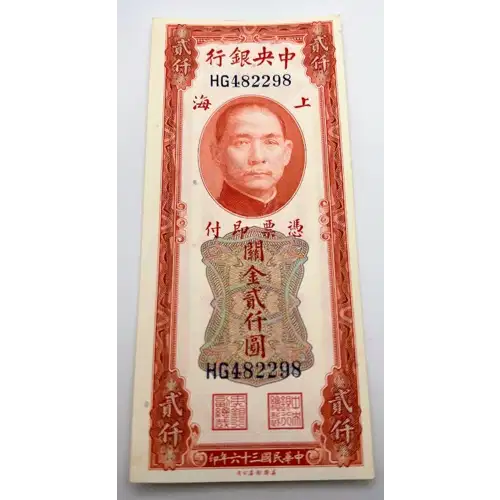
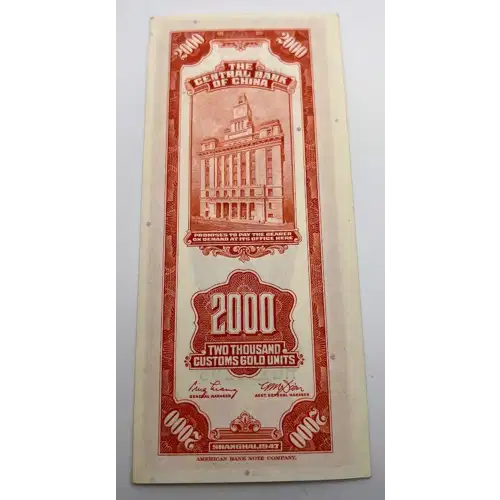
1947 Republic of China 2000 Customs Gold Units P-340 UNC Scarce Currency
Description
This 1947 Republic of China 2,000 Customs Gold Units banknote was issued by the Central Bank of China in Shanghai during the Nationalist government's administration and represents a scarce and historically significant example of Chinese paper currency from the years immediately following World War II. Cataloged as Pick-340, this distinctive issue was printed by the American Bank Note Company, one of the world's foremost producers of engraved banknotes, renowned for its elaborate security printing techniques, intricate artistic designs, and exceptional craftsmanship. The Customs Gold Unit currency system was originally established to facilitate customs duties and certain foreign-exchange-related financial obligations, eventually becoming an important component of China's increasingly complicated monetary system during the economic turmoil of the 1940s. The Chinese-language side prominently features a finely engraved portrait of Dr. Sun Yat-sen, the revolutionary leader and founding father of the Republic of China, positioned within an elegant oval frame near the upper center of the vertically oriented note. His portrait is surrounded by intricate reddish-orange ornamental borders and traditional Chinese decorative elements, while a large multicolored denomination panel appears beneath the portrait, incorporating delicate green, blue, and orange geometric security patterns. Matching serial numbers HG482298, official red seals, and additional denomination markings complete the composition. The English-language side features an impressive architectural engraving of a substantial multistory institutional building with a prominent central clock tower, representing the modern architectural development of Republican-era China. The building is depicted with carefully rendered columns, windows, and architectural details, framed within an elaborate rectangular panel surrounded by intricate reddish-orange geometric security patterns and decorative scrollwork. A prominent denomination panel displaying the value of two thousand Customs Gold Units appears beneath the architectural vignette, accompanied by official bank signatures, the Shanghai place of issue, and the year 1947. The unusual vertical format, richly detailed engraving, and contrasting security designs distinguish this issue from many conventional horizontal banknotes of the period. This example survives in attractive Uncirculated (UNC) condition, displaying crisp, well-preserved paper, strong original coloration, and excellent definition throughout the printed details. The note retains an appealing overall presentation, with the Sun Yat-sen portrait, architectural vignette, denomination panels, official seals, and serial numbers remaining clearly presented. The contrasting reddish-orange engraving, delicate multicolored security patterns, and light paper background highlight the craftsmanship of the American Bank Note Company and contribute to the note's impressive visual appeal. The 1947 date places this banknote within a particularly important period of Chinese monetary history, as the Republic of China struggled with the enormous economic consequences of the Second Sino-Japanese War and the renewed Chinese Civil War. Originally introduced in 1930, Customs Gold Units were intended to provide a more stable accounting unit for customs payments and international trade-related transactions. However, as wartime expenditures, government deficits, and monetary instability intensified, Customs Gold Unit notes eventually entered broader circulation and became part of China's increasingly complex paper currency system. By the late 1940s, accelerating inflation and widespread economic disruption were undermining confidence in the Nationalist government's currency, ultimately contributing to the monetary reforms and political upheaval of 1948 and 1949. High-denomination Customs Gold Unit issues such as this 2,000-unit note provide tangible evidence of the rapidly changing economic circumstances of the period and the efforts of Chinese financial authorities to maintain a functioning monetary system amid extraordinary challenges. As an authentic artifact of postwar Republican China, this 1947 Central Bank of China 2,000 Customs Gold Units banknote offers collectors an appealing combination of historical significance, distinctive high-denomination design, and exceptional preservation. Its Uncirculated condition, scarce Pick-340 attribution, Shanghai issuance, recognizable Sun Yat-sen portrait, detailed clock tower architectural vignette, unusual vertical format, and direct connection to China's turbulent postwar monetary history make it a desirable addition to collections of Chinese paper money, Customs Gold Unit currency, Asian banknotes, and twentieth-century world financial history.