- Gold Au $3856.00 $0.00
- Silver Ag $47.41 $0.40
- Platinum Pt $1434.00 $-17.97
- Palladium Pd $980.50 $9.51
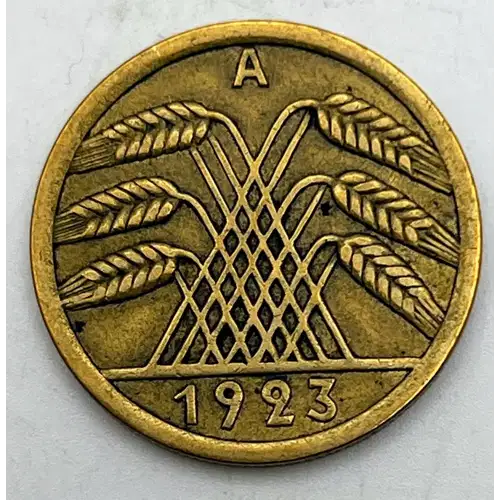
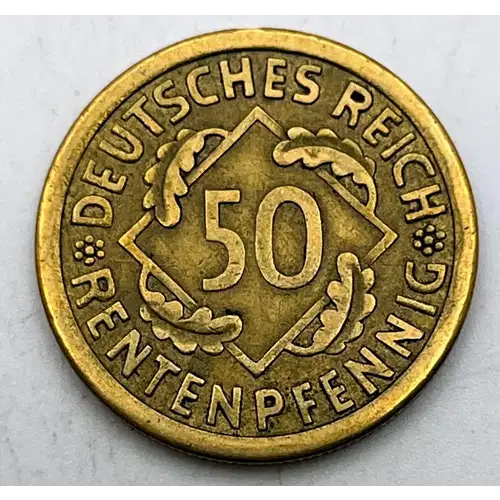
1923-A Germany 50 Rentenpfennig Scarce 1st Year KM-34 Weimar Aluminum Bronze
Category: GERMANY - WEIMAR REPUBLIC Aluminum-Bronze 50 RENTENPFENNIGDescription
This 1923-A German 50 Rentenpfennig, struck at the Berlin Mint during the Weimar Republic, is a scarce first-year issue of Germany's Rentenmark currency system, introduced to restore monetary stability following the devastating hyperinflation crisis of 1923. Cataloged as KM-34, this historically significant denomination represents a pivotal moment in Germany's economic recovery, when the newly established Rentenmark helped stabilize the nation's currency and restore public confidence in its financial system. The obverse features the denomination prominently displayed within a central diamond-shaped frame, surrounded by an elegant arrangement of oak leaves symbolizing strength, endurance, and German national identity. The reverse showcases six stylized ears of grain arranged symmetrically around an intricate central latticework pattern, representing Germany's agricultural productivity and the economic foundations of the Rentenmark system. The Berlin mintmark is positioned above the central design, with the date prominently displayed beneath the agricultural composition. Struck in aluminum-bronze, this piece exhibits attractive circulated preservation with sharply defined lettering, well-presented ornamental details, and distinctive geometric engraving. The surfaces display a pleasing combination of warm golden-bronze and deeper olive-brown patination, complemented by subtle highlights across the raised devices, creating an appealing contrast that emphasizes the coin's classic Weimar-era craftsmanship. This scarce first-year issue represents an important piece of German monetary history and the nation's transition toward economic stabilization following one of the most extraordinary inflationary periods of the twentieth century.