- Gold Au $3856.00 $0.00
- Silver Ag $47.41 $0.40
- Platinum Pt $1434.00 $-17.97
- Palladium Pd $980.50 $9.51
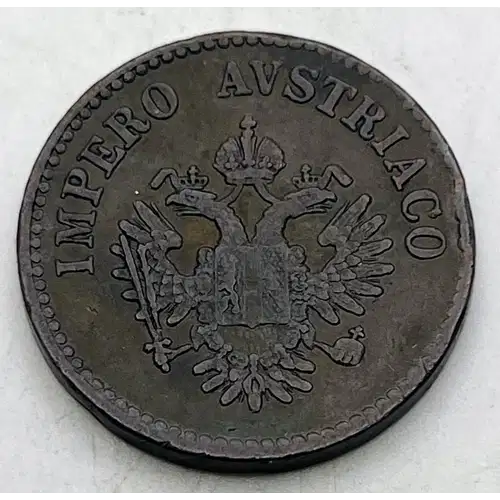
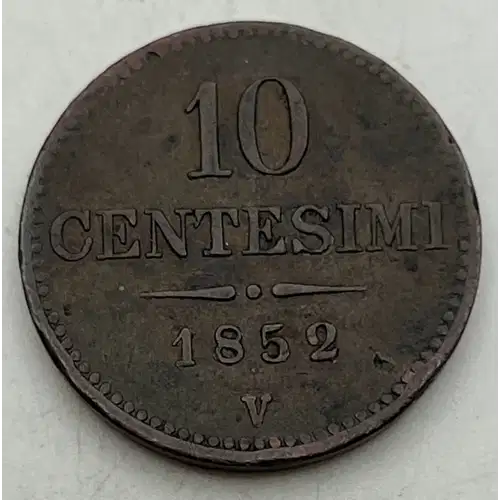
1852-V Italian States Lombardy Venetia under Austrian Rule 10 Centesimi F+
Category: ITALIAN STATES Copper 10 CENTESIMI
Credit Card
Price
–
+
Description
This 1852-V Lombardy-Venetia 10 Centesimi coin was struck at the Venice Mint during the period of Austrian rule over northern Italy and represents an attractive example of mid-nineteenth-century European copper coinage. Issued under Emperor Franz Joseph I of Austria, this denomination circulated within the Kingdom of Lombardy-Venetia, a territory established following the Congress of Vienna in 1815 and governed as part of the Austrian Empire until the gradual unification of Italy. The V mintmark identifies its production at the historic Venice Mint, which had served as an important center of European coin production for centuries. The obverse prominently displays the denomination of 10 Centesimi and the date 1852, with a decorative horizontal ornament separating the lettering from the date and the Venice mintmark positioned below. The reverse features the crowned, double-headed imperial eagle of the Austrian Empire, bearing a central shield and holding traditional symbols of imperial authority. This elaborate heraldic design reflects the political control exercised by the Habsburg monarchy over the Italian territories during the nineteenth century. This example survives in Fine Plus (F+) condition, exhibiting substantial circulation wear while retaining clearly identifiable lettering, date, and principal design elements. The copper surfaces display a rich, dark chocolate-brown patina with subtle reddish-brown highlights around portions of the rim and raised details. Wear is particularly evident across the eagle's central shield, feathers, and crown, while the denomination side remains comparatively well defined. The coin's honest circulated appearance reflects its use in everyday commerce during a period of growing Italian nationalism and political unrest. The Kingdom of Lombardy-Venetia would eventually be divided as Austrian control diminished, with Lombardy joining the Kingdom of Sardinia in 1859 and Venetia becoming part of the unified Kingdom of Italy in 1866. As a historical artifact from this transitional era, this 1852-V 10 Centesimi offers collectors a tangible connection to Habsburg rule in Italy, the longstanding monetary traditions of Venice, and the political developments that ultimately shaped modern Italy. Its historic Venice mintmark, distinctive imperial design, and appealing circulated character make it a worthwhile addition to collections of Italian States coinage, Austrian imperial issues, and nineteenth-century European numismatics.