- Gold Au $3856.80 $0.77
- Silver Ag $47.38 $0.37
- Platinum Pt $1436.40 $-15.57
- Palladium Pd $982.00 $10.98
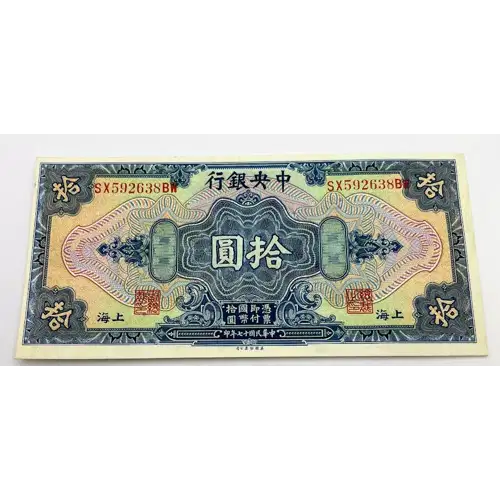
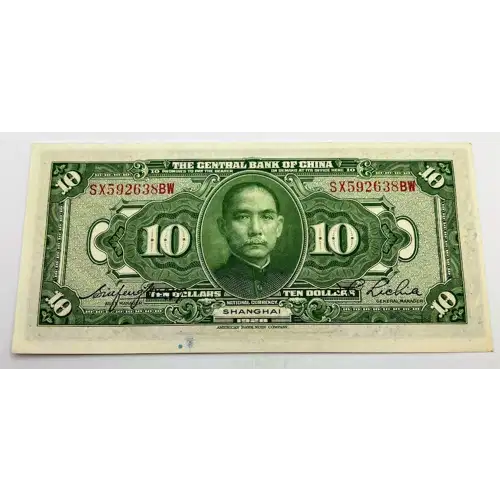
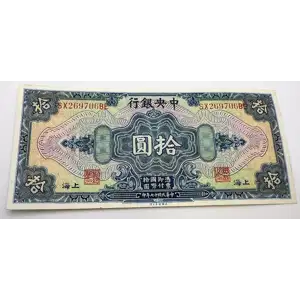
1928 Republic of China 10 Dollars / 10 Yuan P-197 aUNC Central Bank of China Currency
Description
This 1928 Republic of China 10 Dollars (10 Yuan) banknote was issued by the Central Bank of China in Shanghai during the early years of the Nationalist government and represents an attractive example of Chinese paper currency from an important period of financial modernization and political transformation. Cataloged as Pick-197, this distinctive note was produced by the American Bank Note Company, whose sophisticated engraving techniques and elaborate security designs were widely employed by governments and financial institutions throughout the world. The English-language side features a finely engraved portrait of Dr. Sun Yat-sen, the revolutionary leader and founding father of the Republic of China, prominently positioned within an oval frame at the center of the design. Large denomination numerals appear on either side of his portrait, surrounded by elaborate geometric security patterns, decorative scrollwork, and intricately engraved ornamental borders printed in a rich green color. The note also features the Shanghai place of issue, official bank signatures, and matching red serial numbers SX592638BW. The Chinese-language side displays an exceptionally elaborate multicolored design incorporating intricate blue, green, orange, and pink geometric patterns surrounding a prominent central denomination panel. The complex interwoven security designs create an impressive symmetrical composition, while traditional Chinese decorative elements, official red seals, additional denomination markings, and matching serial numbers complete the appearance. The contrasting colors and detailed linework demonstrate the high standards of banknote production associated with the American Bank Note Company during the early twentieth century. This example survives in circulated condition, displaying attractive original coloration, well-defined engraved details, and appealing contrast between the green portrait side and richly colored opposite side. The intricate ornamental borders, central portrait, denomination panels, and serial numbers remain clearly presented, while the paper exhibits the natural character associated with a historical banknote approaching a century in age. Issued in 1928, this note dates to a significant period in Chinese history following the Northern Expedition, when the Nationalist government under Chiang Kai-shek was working to consolidate political authority and strengthen the country's financial institutions. The establishment and expansion of the Central Bank of China formed an important part of these efforts, helping lay the groundwork for subsequent monetary reforms and the eventual introduction of a more unified national currency system. At the time, China's economy still relied heavily on silver-based monetary practices, and the country's banking system remained influenced by regional financial institutions and international trade interests. This 10 Yuan issue reflects the government's broader ambitions to modernize the financial system and establish greater national control over currency issuance. As an authentic artifact of Republican China, this 1928 Central Bank of China 10 Yuan banknote offers collectors a tangible connection to the nation's political development, monetary modernization, and early twentieth-century economic history. Its collectible Pick-197 attribution, Shanghai issuance, recognizable Sun Yat-sen portrait, elaborate American Bank Note Company engraving, and distinctive multicolored design make it a desirable addition to collections of Chinese paper money, Asian banknotes, and historical world currency.