
Published by
Joe Palmieri
Coin Collecting
What Makes a Coin a “Key Date”?
If you spend enough time around coin collectors, you will eventually hear the term “key date.”
Key date coins are some of the most important, desirable, and often most expensive coins in a series.
But what actually makes a coin a key date?
It is not simply about age. It is not always about having the lowest mintage. And it does not automatically mean the coin is extremely rare.
A key date is usually a coin that is significantly harder to obtain than most of the other dates in the same series.
That scarcity, combined with strong collector demand, can make certain dates worth dramatically more than coins that look almost identical.
What Does “Key Date” Mean?
A key date is a coin that collectors typically need in order to complete a set, but that is much harder to find than most of the other coins in that series.
The difficulty may come from:
- A low original mintage
- A low surviving population
- Heavy circulation
- Melting or destruction
- Strong collector demand
- A scarce mintmark
- Limited availability in higher grades
The important part is that the coin creates a bottleneck for collectors.
If thousands of people are building the same set and everyone needs the same difficult date, competition can push prices higher.
Key Dates Are Relative to the Series
A key date should always be considered within the context of the series.
For example, a Morgan dollar collector may consider certain dates essential keys because they are much tougher than the rest of the Morgan dollar series.
A Lincoln cent collector has an entirely different list of key dates.
The same is true for Buffalo nickels, Mercury dimes, Walking Liberty half dollars, and nearly every other collectible U.S. coin series.
A coin does not have to be rare compared with every coin ever made.
It only needs to be unusually difficult compared with the other coins collectors need to complete that particular set.
Low Mintage Often Matters—but Not Always
Many key dates do have low mintages.
That makes sense.
If fewer coins were originally made, fewer are likely to survive.
But mintage alone does not determine whether a coin becomes a key date.
A low-mintage issue that was heavily saved by collectors may still be relatively easy to find.
Meanwhile, a coin with a higher original mintage may become a key date if very few survive today.
That is why collectors also look at surviving population, market availability, and demand.
Survival Rate Can Be More Important Than Mintage
Imagine two coins.
- Coin A had a mintage of 500,000, but collectors saved many of them.
- Coin B had a mintage of 2 million, but most circulated heavily, were lost, melted, or destroyed.
Today, Coin B might actually be harder to find.
This is why surviving population matters so much.
Collectors care about how many examples are actually available now, not just how many were produced originally.
Mintmarks Can Create Key Dates
Sometimes a mintmark is what turns an otherwise ordinary date into a key.
For example, coins from different mint facilities may have very different mintages and survival rates.
A Philadelphia issue may be common while the same year from San Francisco, Denver, Carson City, or another mint could be much scarcer.
That tiny letter can make a tremendous difference in value.
This is one reason collectors should always check the exact date and mintmark before researching a coin.
Condition Can Create a Key Date Within a Grade
Some coins are not especially rare overall, but become extremely difficult in higher grades.
This is known as condition rarity.
A coin may be common in circulated condition but very scarce in Mint State.
For advanced collectors, the high-grade version may function almost like a key date because so few examples exist at that level.
This is especially important in certified coin collecting, where population reports can show how many examples have been graded at each level.
Collector Demand Is a Huge Part of the Equation
A coin can be scarce and still remain affordable if very few people want it.
A key date usually combines scarcity with strong demand.
Popular U.S. coin series often have thousands of collectors trying to complete sets.
That creates intense competition for the hardest dates.
The more collectors who need a particular coin, the more pressure there is on the limited supply.
This is why a key date from a popular series can command a large premium.
Why Do Collectors Pay So Much More for Key Dates?
The simplest answer is supply and demand.
If a series has 50 different dates and 49 are easy to find, the last difficult coin becomes extremely important.
A collector may spend years assembling a nearly complete set and still be missing one or two key dates.
At that point, those coins become the final pieces needed to finish the collection.
Collectors are often willing to pay significantly more for those dates because completing the set may depend on them.
Famous Examples of Key Date Coins
There are many well-known key dates in U.S. numismatics.
Some examples include:
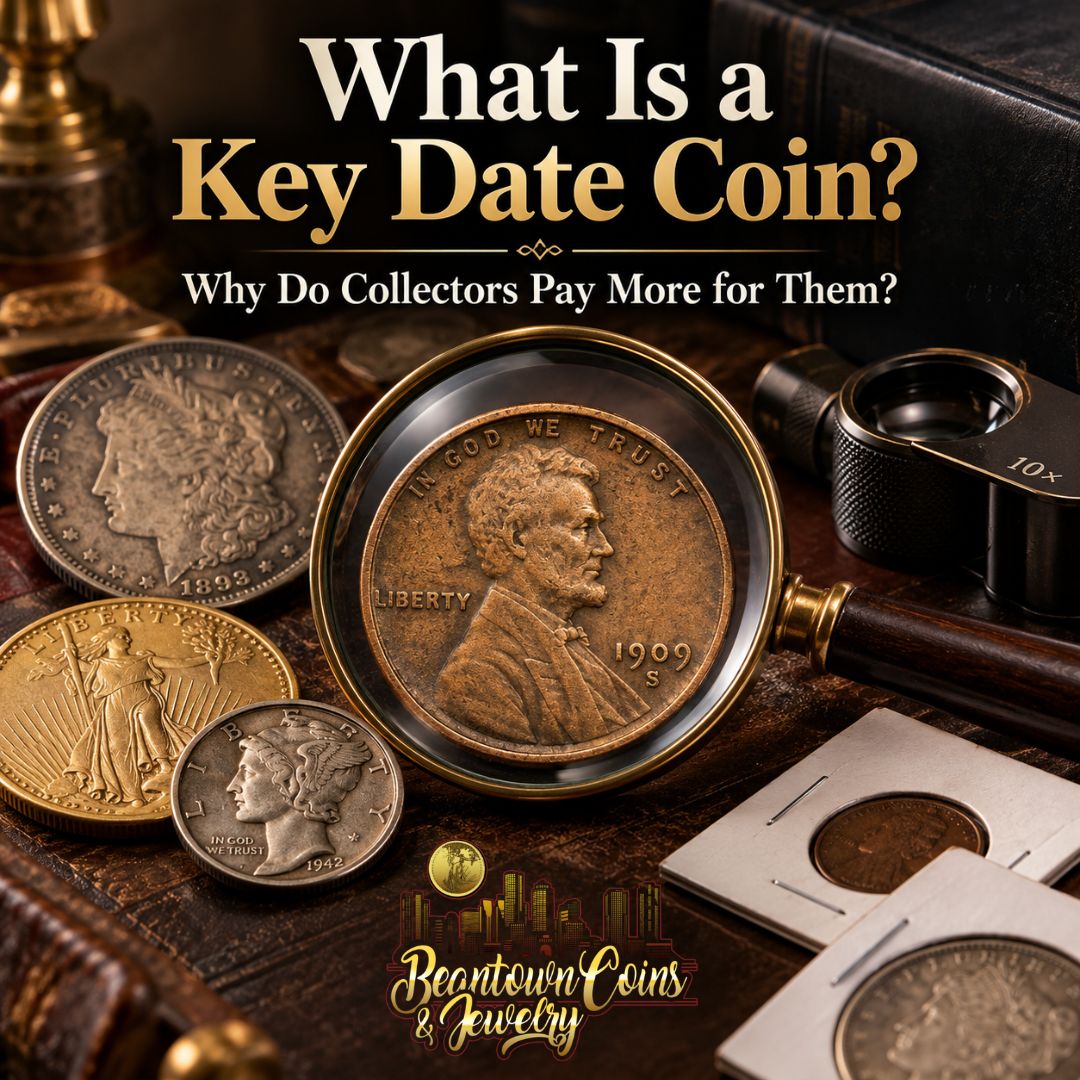
- 1909-S VDB Lincoln cent
- 1914-D Lincoln cent
- 1932-D Washington quarter
- 1932-S Washington quarter
- 1916-D Mercury dime
- 1893-S Morgan dollar
- 1895 Morgan dollar
- 1921 Walking Liberty half dollar
- 1921-D Walking Liberty half dollar
- 1921-S Walking Liberty half dollar
These coins are famous because collectors of their respective series know they can be difficult and expensive to obtain.
However, price depends heavily on condition, authenticity, and market demand.
Want to explore specific examples? Check out our earlier blog on key dates to learn more about some of the important key-date coins we cover and why collectors seek them out.
What Is a Semi-Key Date?
You may also hear the term “semi-key date.”
A semi-key is a coin that is scarcer or more desirable than the common dates, but not quite as difficult as the true key dates.
Semi-key coins can still carry significant premiums.
For collectors building sets, they often represent the next level of difficulty after the main keys.
Depending on the series, semi-key dates can become especially challenging in higher grades.
Key Dates Can Be Counterfeited
Because key date coins are valuable and highly desirable, they are also frequent targets for counterfeiting and alteration.
Common problems can include:
- Added mintmarks
- Altered dates
- Counterfeit coins
- Altered surfaces
- Deceptive repairs
For expensive key dates, authentication becomes extremely important.
A coin that appears to be a famous key date should not automatically be assumed genuine.
Professional certification can provide additional confidence when buying or selling higher-value examples.
Cleaning Can Affect a Key Date’s Value
A key date can still be valuable even if it has been cleaned or damaged.
However, condition problems can significantly affect price.
A problem-free example with original surfaces may sell for considerably more than a cleaned or damaged example of the same date and mintmark.
Because key dates are already scarce, even lower-grade examples may still be desirable.
But collectors generally pay the strongest premiums for attractive, original coins.
Why Key Dates Are So Important to Set Collectors
Many collectors enjoy assembling complete sets by date and mintmark.
The common dates may be relatively easy to acquire.
The key dates are what make the challenge interesting.
Finding that difficult final coin can become the highlight of the entire collecting experience.
That is one reason key dates often become some of the most memorable coins in a collection.
They represent not just value, but achievement.
Does Every Coin Series Have a Key Date?
Not necessarily.
Some series have very clear key dates.
Others have several scarce issues without one dominant key.
Ancient and world coins may also be collected differently, so the concept of a key date may not always apply in the same way.
The term is most commonly used in date-and-mintmark collecting, especially for U.S. coins.
How Can You Tell If Your Coin Is a Key Date?
Start by identifying the exact coin.
Check the:
- Denomination
- Date
- Mintmark
- Variety
- Condition
- Certification
Then compare it with a reliable reference for that series.
A current coin guide, grading service price guide, auction archive, or specialty reference can help identify which dates are considered keys.
If the coin appears to be valuable, check recent completed sales rather than relying only on asking prices.
Be Careful with Online Listings
If you own a key date, online prices can vary dramatically.
One seller may ask $500.
Another may ask $2,000.
A certified high-grade example may sell for much more.
A cleaned or damaged example may sell for much less.
That is why comparing the exact date alone is not enough.
You need to compare the exact coin as closely as possible.
Are Key Dates Good Coins to Collect?
For many collectors, yes.
Key dates can be especially appealing because they combine scarcity, demand, and importance within a series.
However, they can also be expensive.
Some collectors buy the key dates first because they expect those coins to become harder to find.
Others build the common portion of the set first and save the keys for later.
There is no single correct approach.
It depends on your budget and collecting goals.
Should You Buy the Key Dates First?
This is a common strategy among experienced collectors.
The reasoning is simple:
Common dates are usually easier to find later.
Key dates may be more difficult to replace if prices rise or availability decreases.
Buying the difficult coins first can make completing the rest of the set easier.
However, collectors should still prioritize quality, authenticity, and overall value rather than rushing into an expensive purchase.
Key Dates Are About More Than a Low Number
A key date is not just a coin with a small mintage.
It is a coin that becomes difficult because of the combination of:
Scarcity + Survival + Demand + Condition + Set-Building Importance
That is what makes collectors compete for them.
And that competition is what can make key dates some of the most valuable coins in a series.
Want to Find the Key Dates in Your Collection?
One of the easiest ways to learn which dates and mintmarks are considered important within a U.S. coin series is to use a current Official Red Book: A Guide Book of United States Coins.
The Red Book includes mintages, key dates, varieties, grading information, historical background, and estimated values for thousands of U.S. coins.
It is a useful reference whether you are building a collection, researching inherited coins, or simply trying to understand why one date may be much harder to find than another.
View the current Official Red Book on Amazon
Remember that printed values are a starting point. Actual market prices can vary based on condition, certification, eye appeal, demand, and recent sales.
Think You Might Have a Key Date Coin?
At Beantown Coins, we evaluate U.S. coins, world coins, ancient coins, gold, silver, paper money, and other numismatic material.
If you have a coin that you believe may be a key date, bring it in exactly as you found it.
We can help identify the exact date and mintmark, evaluate its condition, discuss authenticity, and explain where it fits within the series.
Sometimes a tiny mintmark or small detail can make a very big difference.