Published by
Joe Palmieri
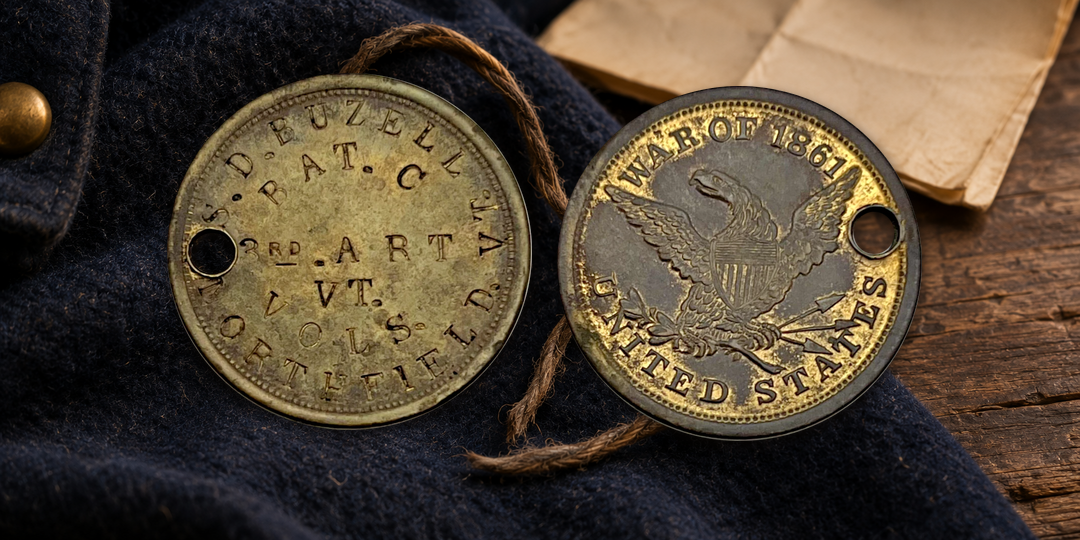
In the world of numismatics and historical collectibles, few items carry the weight of personal stories quite like Civil War artifacts. Today, we're diving into one such treasure: an original dog tag belonging to Samuel D. Buzzell, a Union soldier from Vermont whose service spanned key moments of the conflict. This piece not only represents the grit of the era but also connects us to the human side of America's deadliest war. At Beantown Coins, we're thrilled to have this remarkable artifact in our inventory, available for discerning collectors looking to own a slice of history!
The Artifact: A Window into a Soldier's Life
Dog tags, or identification discs, emerged during the Civil War as a practical solution for soldiers facing the uncertainties of battle. Unlike modern versions, these early tags were often privately made, stamped with personal details to ensure identification if the worst occurred. Buzzell's tag is a fine example: a brass disc with an eagle motif on the front, retaining much of its original gold wash for that authentic patina. The reverse is stamped with "S.D. Buzzell Bat. C 3rd Art. Vt. Vols. Northfield, VT," pinpointing his unit as Battery C of the 3rd Vermont Light Artillery.
Dating back to the early 1860s style, this tag is a tangible link to the volunteer's spirit that defined the Union Army. It's not just metal—it's a testament to the everyday heroes who answered the call, often leaving farms and families behind. Items like this are increasingly rare, as many were lost to time or the battlefield, making Buzzell's tag a standout for any Civil War enthusiast.
Samuel D. Buzzell: From Vermont Farms to Front Lines
Born around 1837 in Northfield, Vermont, Samuel D. Buzzell was a typical New Englander—likely a farmer or tradesman—when the Civil War erupted in 1861. Like many, he didn't enlist immediately but joined the fray in October 1862, mustering into the 12th Vermont Volunteer Infantry for a nine-month term. This regiment, organized in Brattleboro, Vermont, was part of the "Stannard Brigade," a group of short-term volunteers raised to bolster Union defenses amid growing Confederate threats.
Buzzell's early service with the 12th involved picket duty at Fairfax Courthouse through late 1862, followed by guarding railroads in early 1863. But the regiment's defining moment came in late June 1863, when they marched northward to intercept Robert E. Lee's invasion of Pennsylvania. Arriving at Gettysburg on July 1—the first day of the infamous three-day battle—the 12th Vermont was assigned to protect vital supply trains. While they didn't engage directly in the frontline fighting, their role was crucial: safeguarding ammunition and provisions that sustained the Union forces during one of the war's bloodiest clashes. After the battle, Buzzell and his comrades guarded Confederate prisoners during their transfer to Baltimore, a grueling task that underscored the war's harsh realities.
Mustering out in mid-July 1863, Buzzell could have returned home, but his commitment didn't end there. In January 1864, he reenlisted with the 3rd Vermont Light Artillery, Battery C—a unit formed specifically for artillery support in the Union's ongoing campaigns. This battery moved to Washington, D.C., for defensive duties before joining the siege operations around Petersburg, Virginia.
Here, Buzzell's service intensified. On July 30, 1864, his battery provided fire support during the Battle of the Crater, a disastrous Union attempt to breach Confederate lines via an underground mine explosion. The engagement was chaotic and costly, but Buzzell's unit held firm. Later, at Petersburg, they fired multiple barrages, including the pivotal signal round on April 2, 1865, that initiated the final assault on Confederate positions—hastening the end of the siege and Lee's eventual surrender at Appomattox.
Adding a poignant layer, Buzzell participated in memorial services following President Abraham Lincoln's assassination in April 1865. Historical accounts note that members of his battery, including artillerymen like Buzzell, fired salutes during these somber events, honoring the fallen leader who had guided the nation through its darkest hour.
Buzzell mustered out in June 1865, returning to civilian life in Vermont. He lived until 1911, passing at age 74, but his dog tag endures as a symbol of his enduring service.
Why This Dog Tag Matters Today
The Civil War reshaped America, and artifacts like Buzzell's dog tag remind us of the individuals who fought for unity and freedom. Vermont troops, though from a small state, played outsized roles—over 34,000 Vermonters served, with units like the 12th Infantry and 3rd Artillery exemplifying resilience. At Gettysburg alone, Vermont regiments helped turn the tide, and Buzzell's proximity to that pivotal battle adds immense historical value.
For collectors, this tag offers more than rarity; it's authenticated through service records and unit histories, with its condition reflecting careful preservation. It's a conversation starter, a teaching tool, and an investment in tangible history—values that often appreciate as interest in Civil War memorabilia grows.
Add This Piece to Your Collection
At Beantown Coins in St. Petersburg, Florida, we specialize in rare coins and historical artifacts that tell stories like this one. Samuel Buzzell's Civil War dog tag is currently available in our shop for $2,900—a fair price for such a well-documented, battlefield-connected item. Whether you're a seasoned numismatist or a history buff building your display, this tag deserves a place in your collection. Stop by our store or visit our eBay page to inquire—our experts are here to help you secure this piece of American heritage. Don't forget to ask about our appraisal services for your own treasures!
Beantown Coins & Jewelry
Buy. Sell. Trade. Appraise.